For years, marketers have repeated the same phrase:
“Attention is the new currency.”
It sounds intelligent. It feels strategic. It’s incomplete.
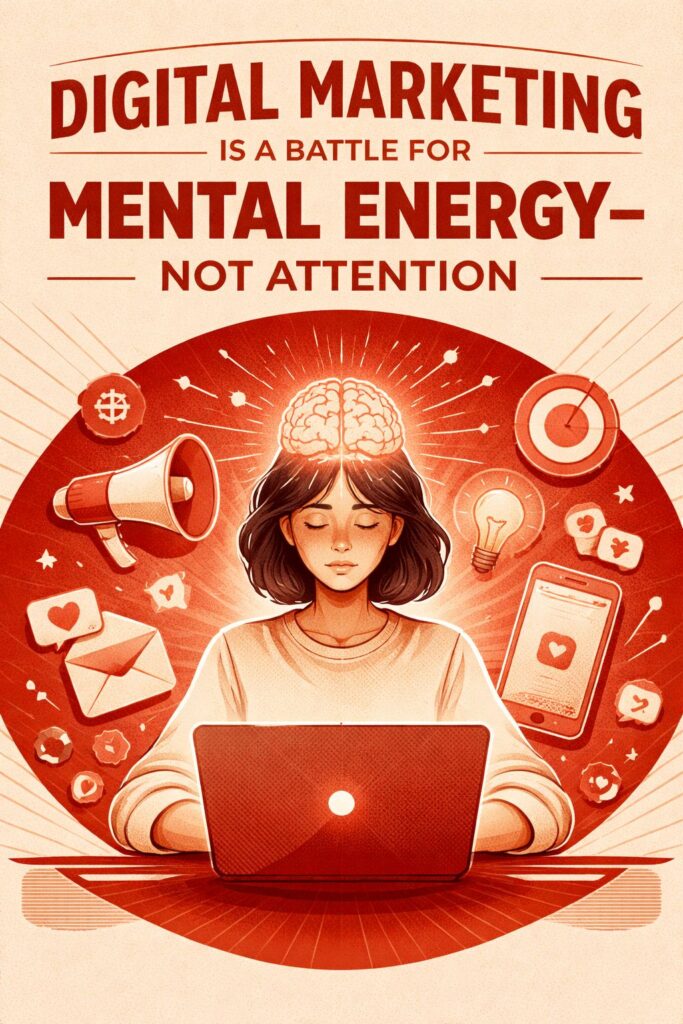
Attention is not scarce.
Mental energy is.
People scroll for hours. They look at hundreds of posts. They open dozens of tabs. Attention exists in abundance.
What doesn’t exist in abundance is cognitive bandwidth — the mental capacity required to process, evaluate, and decide.
And that changes everything.
The Age of Cognitive Overload
We are not living in an attention economy.
We are living in an economy of overstimulation.
Notifications. Emails. Reels. Ads. Headlines. Pop-ups.
Every brand is louder than the next.
When the brain is overloaded, it does something predictable:
It avoids effort.
If your website requires thinking, comparing, decoding, or guessing people leave.
Not because they weren’t interested.
Because they were tired.
This is called decision fatigue — the decline in decision quality after repeated choices. When people are mentally drained, they default to the simplest option: do nothing.
No click.
No inquiry.
No purchase.
Why Most Marketing Fails
Most brands assume the problem is visibility.
So they:
Increase posting frequency
Add more CTAs
Add more animations
Add more urgency
Add more noise
They try to win attention.
But complexity increases cognitive friction — the mental effort required to understand something.
And friction repels.
The truth is uncomfortable:
If people don’t convert, it’s rarely because you didn’t attract them.
It’s because you exhausted them.
Mental Energy Is the Real Currency
When someone lands on your website, they are unconsciously asking:
Is this clear?
Is this safe?
Is this worth my effort?
Do I understand what to do next?
If the answer is not immediately obvious, they disengage.
Clarity reduces effort.
Structure reduces uncertainty.
Simplicity reduces hesitation.
That’s why minimalist brands often convert better than visually chaotic ones.
Not because they are “prettier.”
Because they are easier to process.
In behavioral research, this is known as processing fluency — when something is easy to understand, we perceive it as more trustworthy and more intelligent.
Ease feels like credibility.
What This Means for Your Brand
If digital marketing is a battle for mental energy, then your job is not to shout louder.
It is to simplify better.
Ask yourself:
Is my message immediately clear?
Is my layout guiding the eye?
Are my calls-to-action obvious without being aggressive?
Am I reducing decisions or adding more?
High-converting brands remove friction before adding persuasion.
They respect mental energy.
And that respect builds trust.
The Strategic Shift
Stop chasing attention metrics.
Start designing for cognitive ease.
Because in a world overwhelmed by information, the brand that requires the least effort often wins.
Not the loudest.
Not the flashiest.
The clearest.